Enrolling in Skill Development Course – Abacus Course
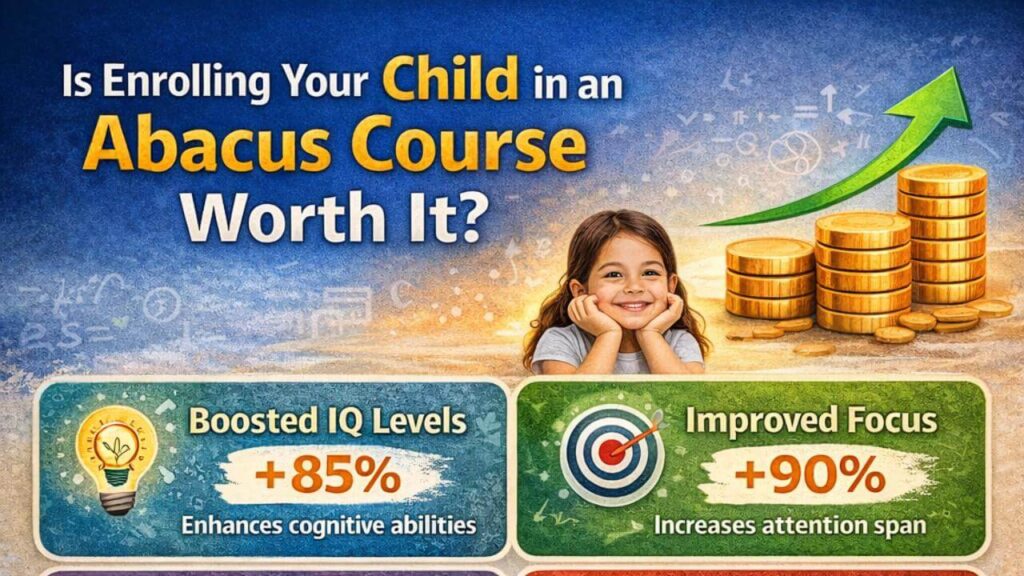
Is It an Investment or an Expense?
Let’s study first whether any skill development courses for kids are to be considered an expense or an investment.
Here are 4 facts to consider when determining if such courses are an expense or an investment:
Long-Term Benefits
Skill development courses for kids often provide them with valuable skills and knowledge that can benefit them throughout their lives. For example, learning a new language, coding, or musical instrument can open up new opportunities and enhance their cognitive development. In this sense, these courses can be viewed as an investment in their future.
Improved Academic Performance
Some skill development courses can help children perform better in school by enhancing their problem-solving abilities, creativity, and critical thinking skills. If the courses lead to improved academic performance and better educational prospects, they can be seen as an investment in their education.
Enhanced Confidence and Self-Esteem
Skill development courses can boost a child’s confidence and self-esteem by allowing them to excel in a particular area of interest. This improved self-confidence can have a positive impact on their personal and professional lives in the long run, making it an investment in their overall development.
Long-Term Value Over Upfront Cost
Skill development courses do come with upfront costs but, their long-term benefits, including improved skills, academic performance, confidence, and potential future opportunities, can make them a valuable investment in a child’s development.
Also read: What is abacus teacher training?
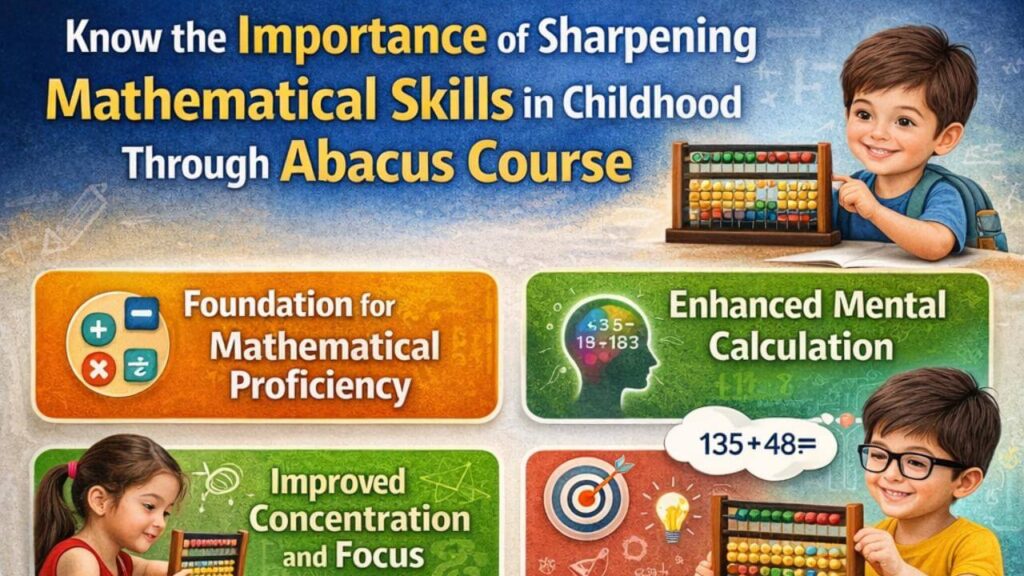
Know the Importance of Sharpening Mathematical Skills in Childhood Through Abacus
Sharpening mathematical skills in childhood through the Abacus offers several significant benefits, contributing to a child’s overall development. Here are some key reasons for the importance of this educational approach:
Foundation for Mathematical Proficiency
Abacus courses provide a strong foundation in basic mathematical concepts, including addition, subtraction, multiplication, and division. These fundamental skills are essential for success in more advanced math topics.
Enhanced Mental Calculation
Abacus training encourages mental calculation and strengthens a child’s ability to perform mathematical operations quickly and accurately without relying on calculators or external aids. This mental agility can be a valuable skill in everyday life.
Improved Concentration and Focus
Learning to manipulate the Abacus requires sustained attention and concentration. Over time, this can lead to improved focus, attention to detail, and discipline, which can benefit a child in various aspects of their education and life.
Spatial and Visual Skills
The Abacus requires children to visualize and manipulate numerical concepts in a spatial format. This enhances their spatial and visual reasoning skills, which can be valuable in subjects beyond mathematics, such as science and engineering.
Confidence Building
As children progress in Abacus courses and become proficient in mental calculations, they gain confidence in their mathematical abilities. This newfound confidence can positively impact their overall attitude towards math and learning.
Cultivation of Logical Thinking
Abacus training fosters logical thinking and problem-solving skills. Children learn to break down complex problems into smaller, more manageable steps, which is a valuable skill in mathematics and other academic disciplines.
Early Exposure to Math
Starting math education at an early age through the Abacus can create a lifelong interest in mathematics. When children find math enjoyable and accessible, they are more likely to pursue STEM (science, technology, engineering, and mathematics) fields in the future.
Complementary Learning
Abacus training can complement traditional math education methods. It provides an alternative approach to learning math that some children may find more engaging and effective.
Cultural Appreciation
The Abacus has cultural significance in various parts of the world, such as Japan and China. Learning about the Abacus can introduce children to different cultures and foster a sense of global awareness and appreciation.
Life Skills
The mathematical skills acquired through the Abacus Course have practical applications in everyday life, from managing finances to problem-solving in various situations.
Try Our Online Abacus Simulator
5 Myths About Abacus Course
Myth 1: Abacus Is Outdated
One prevalent myth is that the Abacus is an outdated and obsolete tool in the age of calculators and computers. However, the Abacus remains a valuable educational tool for developing mental math skills and mathematical understanding. It’s not about replacing modern technology but complementing it with foundational skills.
Myth 2: Only for Math Geniuses
Some people believe that the Abacus Course is suitable only for exceptionally gifted children in mathematics. In reality, Abacus training is accessible to children of all abilities and can help improve their mathematical skills and confidence regardless of their initial proficiency.
Myth 3: Limited to Mathematics
Another misconception is that the Abacus focuses solely on mathematics. While math is a primary component, Abacus training also promotes cognitive development, concentration, and problem-solving abilities. These skills have broader applications in various academic and real-life situations.
Myth 4: Time-Consuming
Some parents worry that Abacus training will require excessive time and effort from their children, interfering with their regular schoolwork and extracurricular activities. In reality, Abacus programs are designed to be flexible and accommodating to a child’s schedule, allowing them to balance their studies effectively.
Myth 5: Cultural Restrictions
There’s a misconception that Abacus training is only relevant to certain cultures, such as Asian cultures where it has historical significance. However, Abacus courses are available worldwide, and their benefits are not limited by cultural background. They can be valuable for children from diverse backgrounds.
Also read: Abacus vs Vedic Maths: Are They Same or Different? Complete Guide
Conclusion
In conclusion, these myths about the Abacus Course often lead to misunderstandings and missed opportunities for children’s education. Abacus training is a versatile and beneficial educational approach that can enhance mathematical skills, cognitive development, and overall confidence in children, irrespective of these misconceptions.
Ready to Get Started?
Give your child the gift of strong math skills and better confidence with our Abacus Course.
👉 Book A Free Trial Class Now – Let your child experience the difference.
👉 Apply For Franchise – Start your own Abacus center and grow with us.
📲 Don’t forget to follow us on social media for updates, tips, and success stories! Facebook, Instagram, You tube, LinkedIn, Twitter
FAQs
Q: What is an abacus course?
Ans: An abacus is a structured program that teaches individuals, typically children, how to use the abacus, an ancient counting tool, for mental arithmetic and math skill development.
Q: Who can take an abacus course?
Ans: Abacus courses are primarily designed for children aged 5 and above. However, adults interested in improving their mental math skills can also enroll in such courses.
Q: What are the benefits of learning the abacus?
Ans: Learning the abacus can improve mental math skills, enhance concentration, boost memory, and increase overall math proficiency. It also helps develop problem-solving abilities.
Q: How long does an abacus course typically last?
Ans: The duration of an abacus course can vary, but most basic courses span from 3 to 6 months. Advanced courses may extend to 1-2 years or more.
Q: What will my child learn in an abacus course?
Ans: In an abacus course, children learn how to perform calculations using the abacus, starting with basic addition and subtraction and progressing to more complex operations, including multiplication and division. They also develop mental math techniques.
Q: Are there any prerequisites for enrolling in an abacus course?
Ans: No specific prerequisites are needed. Abacus courses are designed for beginners, and students do not need prior math knowledge.
Q: How are abacus courses taught?
Ans: Abacus courses are typically taught in a classroom setting by qualified instructors. Students learn through hands-on practice with the abacus, worksheets, and verbal instructions.
Q: Can my child continue practicing abacus skills at home?
Ans: Yes, most abacus courses provide practice materials and recommend daily practice at home to reinforce skills learned in class.
Q: Will learning the abacus interfere with my child’s regular math studies?
Ans: Learning the abacus can complement regular math studies. It often enhances a child’s understanding of math concepts and improves their overall math skills.
Q: How can I find a reliable abacus course for my child?
Ans: You can search for abacus courses through local educational centers, online platforms, or recommendations from other parents. Ensure the course is taught by qualified instructors and has a good reputation.
Q: Can adults benefit from taking an abacus course?
Ans: Yes, adults can benefit from abacus courses as well. It can help improve mental math abilities, especially if they want to enhance their calculation skills for daily life or work.
Q: Is there any certification or recognition for completing an abacus course?
Ans: Some abacus courses offer certificates upon completion, but recognition may vary depending on the course provider. It’s essential to inquire about certification before enrolling.
Q: Are abacus courses expensive?
Ans: The cost of abacus courses varies depending on location, duration, and the course provider. It’s advisable to research different options and compare prices.
Q: Can I enroll in an abacus course online?
Ans: Yes, there are online abacus courses available, which can be a convenient option for both children and adults. Ensure the online course is reputable and provides adequate support and materials.
Q: How can I track my child’s progress in an abacus course?
Ans: Most abacus courses provide regular assessments to track a student’s progress. You can also communicate with the instructor to get updates on your child’s development.