
Diffrence Between Abacus and Vedic Maths / Are Vedic maths and Abacus same / both same / Difference between Abacus and Vedic Maths / which one is better among Abacus and Vedic Maths ? / Are both course successful in school curriculum ?
Before exploring the difference between Abacus and Vedic Maths , One should know in detail what these courses as stand alone. So lets explore
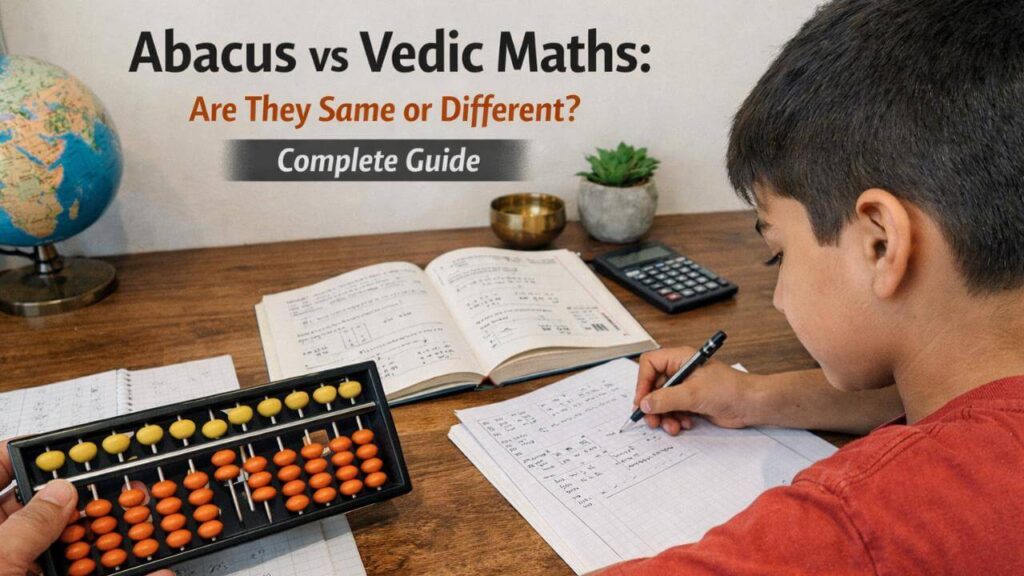
What is Abacus ?
An abacus is a simple counting tool that consists of a frame with beads or rods that can be moved to perform mathematical operations. The beads or rods are typically arranged in columns, with each column representing a place value (e.g. ones, tens, hundreds, etc.). The user moves the beads or rods to perform mathematical operations such as addition, subtraction, multiplication, and division.
The traditional abacus, also known as a “soroban,” is used in many countries and has been used for centuries. It is still used in many parts of the world as a tool to teach basic arithmetic. It can also help students develop their ability to perform mental calculations and visualization skills.
Abacus typically come in two type of abacus one with beads sliding on wire and other with beads sitting in a groove.
In summary, an abacus is a physical tool that consists of a frame with beads or rods that can be moved to perform mathematical operations. It is typically used to teach basic arithmetic and to help students develop their mental calculation and visualization skills.
Try Our Online Abacus Simulator
What is Vedic Maths ?
Vedic Mathematics is a system of mathematics that is based on ancient Indian texts. It is a collection of techniques, algorithms and methods to solve mathematical problems in an efficient and easy way. These techniques are said to have been passed down through oral tradition, and were rediscovered in the early 20th century by Sri Bharati Krsna Tirthaji, who claimed to have found them in the Vedas, the ancient sacred texts of Hinduism.
Vedic mathematics is based on the principle of verbal formulae and memory, instead of the traditional notion of mathematical formulae and symbols. It uses a set of sutras, or word-formulae, that represent the different techniques and shortcuts. These sutras can be applied to a wide range of mathematical problems, including algebra, geometry, and trigonometry. It is said to be a powerful tool for solving mathematical problems, as it allows for quick and efficient calculations.
In summary, Vedic mathematics is a system of mathematics based on ancient Indian texts. It uses a set of techniques and shortcuts to perform calculations quickly and efficiently, which can be applied to a wide range of mathematical problems. It is based on the principle of verbal formulae and memory, instead of the traditional notion of mathematical formulae and symbols.
Is Vedic maths and Abacus same
No, Vedic mathematics and abacus are not the same.
Vedic mathematics is a system of mathematics that is based on ancient Indian texts. It uses a set of techniques and shortcuts to perform calculations quickly and efficiently. These techniques can be applied to a wide range of mathematical problems, including algebra, geometry, and trigonometry. It is not limited to just arithmetic operations. Vedic mathematics can be used to solve complex mathematical problems with ease and efficiency.
Abacus, on the other hand, is a physical tool that consists of a frame with beads or rods that can be moved to perform mathematical operations. It is typically used to teach basic arithmetic, such as addition, subtraction, multiplication, and division. It can also help students develop their ability to perform mental calculations and visualization skills.
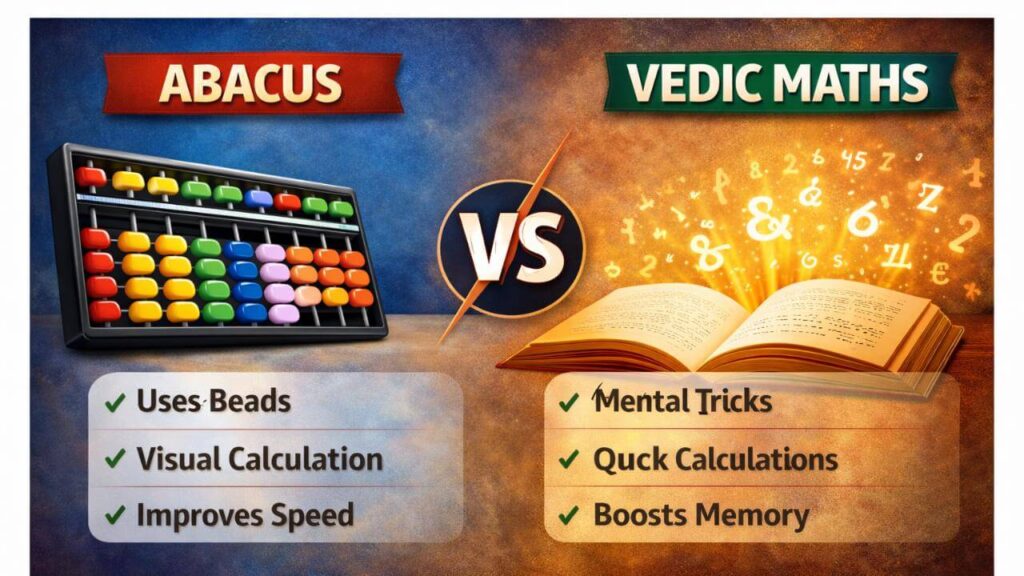
Which One Is Better in Abacus and Vedic Maths ?
Both abacus and Vedic mathematics are methods of performing mathematical calculations, and they each have their own strengths and weaknesses.
Abacus is a physical tool that can help students develop their ability to perform mental calculations and visualization skills. It can also be useful for learning basic arithmetic operations, such as addition, subtraction, multiplication, and division.
Vedic mathematics, on the other hand, is a system of mathematics that is based on ancient Indian texts. It uses a set of techniques and shortcuts to perform calculations quickly and efficiently. These techniques can be applied to a wide range of mathematical problems, including algebra, geometry, and trigonometry.
Abacus is a lot better than Vedic maths according to me.
Vedic maths is a combination of tricks, specific to the different types of numbers.
Abacus doesn’t have any tricks, it’s a technique.
Vedic maths requires you to remember these techniques, identify the technique which is applicable to the particular calculation, and then use it.
Abacus is a uniform technique. There’s nothing to remember, all you need is a good amount of practice. This practice doesn’t just makes calculation faster, it improves concentration as well. It’s very good for kids for their mental growth.
But still it is difficult to say which is better as it depends on the individual’s learning style and goals. If one wants to improve mental calculation and visualization, abacus is a good option. If one wants to improve speed and efficiency of calculation, vedic mathematics could be a good option.
Key Diffrence between Abacus and Vedic Maths
The key difference between Abacus and Vedic mathematics is in their method of performing mathematical calculations.
Another major difference is the scope of application. Abacus is mainly used for teaching basic arithmetic and visualization, whereas Vedic mathematics is used to solve complex mathematical problems with ease and efficiency.
which course among Abacus and Vedic math is successful as after school program .
Abacus programs can be a great way to help students improve their math skills and develop their ability to perform mental calculations and visualization skills. However, there are some potential drawbacks of choosing Abacus as an after-school program, such as:
Difficulty with spatial visualization or fine motor skills: Some students may have difficulty manipulating the beads or rods on the abacus, which can make it difficult for them to fully engage with the program and benefit from it.
One potential drawback of using Abacus as an after-school program is that it requires hands-on practice and physical manipulation of the beads or rods on the abacus. If students are absent from the program, they may miss out on important practice and instruction. This can make it difficult for them to catch up and fully engage with the program, which can negatively impact their progress and success.
Additionally, if the program lacks a proper structure and students are not being provided with enough practice, they may not be able to develop their mental calculation and visualization skills to a satisfactory level. This can make it difficult for them to see the full benefits of the program and to make progress in math.
Furthermore, if the program does not have a good teacher or teachers who are not well-trained in teaching Abacus, the students may not be able to fully grasp the concepts and techniques of using Abacus, which can lead to a less successful program.
In summary, Abacus programs require hands-on practice and physical manipulation of the beads or rods on the abacus, and if students are absent from the program, they may miss out on important practice and instruction. This can make it difficult for them to catch up and fully engage with the program, which can negatively impact their progress and success. Additionally, a lack of structure, practice, and qualified teachers can also make it less successful.
Vedic mathematics can be a great after-school program for students who are interested in math and want to improve their speed and efficiency in solving mathematical problems. Some benefits of using Vedic mathematics as an after-school program include:
- Efficiency: Vedic mathematics uses a set of techniques and shortcuts to perform calculations quickly and efficiently. This can be beneficial for students who want to improve their math skills and complete mathematical problems in a shorter amount of time.
- Problem-solving skills: Vedic mathematics is based on a set of sutras (word-formulae) and encourages the use of problem-solving and critical thinking skills. This can be beneficial for students who want to improve their problem-solving skills and apply them to other areas of their lives.
- Flexibility: Vedic mathematics can be applied to a wide range of mathematical problems, including algebra, geometry, and trigonometry, not just basic arithmetic operations. This can be beneficial for students who want to improve their math skills across a variety of mathematical concepts.
- Mental calculation: Vedic mathematics is based on the principle of verbal formulae and memory, instead of the traditional notion of mathematical formulae and symbols. This can be beneficial for students who want to improve their mental calculation skills.
In summary, Vedic mathematics can be a great after-school program
But it’s’s important to keep in mind that every student is different and what works for one student may not work for another. It’s important to evaluate the curriculum, instructors, and student’s needs, before choosing a program.
Conclusion (Abacus vs Vedic Maths)
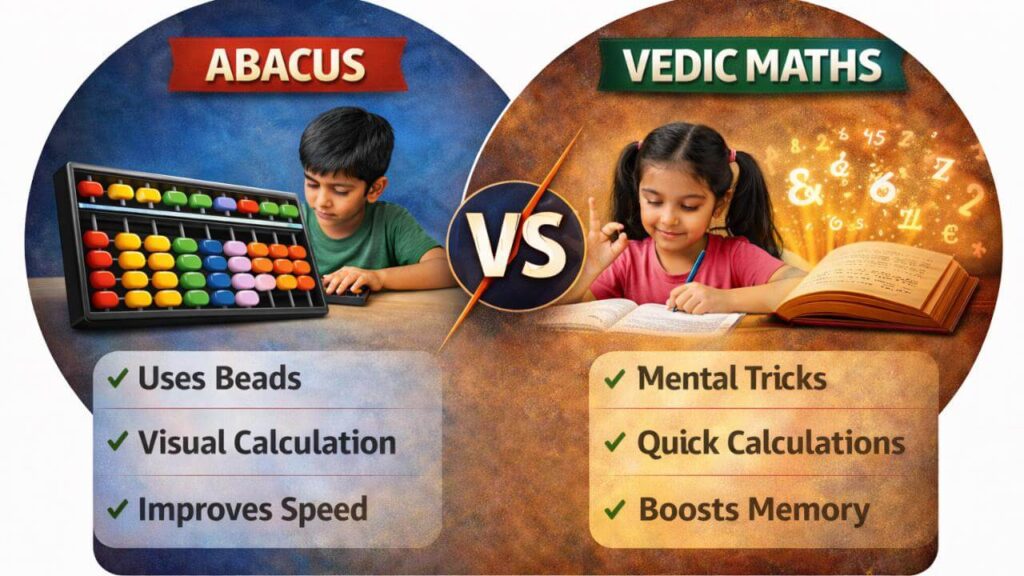
Abacus and Vedic Maths are both methods of doing calculations, but they are quite different. Abacus is a physical tool used to perform calculations. It consists of beads or other small objects strung on a frame. The user moves the beads according to a set of rules to do mathematical calculations.
Vedic Maths is an ancient system of mathematics developed in India. It is based on 16 sutras (formulas) that simplify calculations and allow them to be done very quickly. Vedic Maths is mental in nature and does not require any physical tools.
The main difference between Abacus and Vedic Maths is that Abacus is a physical tool and Vedic Maths is a mental system. Abacus is used for basic arithmetic like addition, subtraction, multiplication, and division. Vedic Maths is used for more complex calculations like algebra and calculus. Another difference between Abacus and Vedic Maths is that Abacus is best used for doing simple calculations quickly, while Vedic Maths is better suited for more complex calculations. Abacus is also more suited for younger learners, as the physical tool helps keep them engaged. Vedic Maths is more suitable for older learners,
Ready to Boost Your Child’s Math Skills?
Book A Free Trial Class Now and experience the power of Abacus & Vedic Maths learning!
- Want to start your own successful education business?
- Apply For Franchise today and grow with us!
📲 Stay updated with tips, success stories, and learning videos —
Follow us on our social media platforms Facebook, Instagram, You tube, LinkedIn, Twitter and join our smart learning community!
FAQs
Q: What is the main difference between Abacus and Vedic Maths?
Ans: Abacus is a physical calculation tool that helps students perform arithmetic using beads, while Vedic Maths is a mental calculation system based on 16 ancient sutras that make problem-solving faster and easier.
Q: Which is better for children – Abacus or Vedic Maths?
Ans: Abacus is generally more suitable for younger children because it improves concentration, visualization, and basic arithmetic skills. Vedic Maths is ideal for older students who want to enhance mental speed and solve complex problems quickly.
Q: Is Vedic Maths difficult to learn?
Ans: No, Vedic Maths is designed to simplify calculations. With proper guidance and practice, students can learn it easily and improve their calculation speed significantly.
Q: How can I enroll in a trial class?
Ans: You can easily Book a Free Trial Class Now through our website to experience our teaching method firsthand.